YouTube, 11 January 2013
http://www.youtube.com/watch?feature=player_embedded&v=PODCa9sA34A
Neat video of flight over the moon. This was the last minutes of video from Nasa's Grail Mission satellite from about 6 miles above the moon.
Neat video of flight over the moon. This was the last minutes of video from Nasa's Grail Mission satellite from about 6 miles above the moon.
We've collected, computed, or inferred important data such as asteroid mass and composition from multiple scientific sources. With this information, we estimate the costs and rewards of mining asteroids.
There were no vehicles announced, no disclosure of customers or investors, no mission plans or detailed slideshows. The prices quoted, while a bargain compared to what's currently being spent on space exploration, were still impossible for anyone except nations and the richest individuals to afford. The new company itself would not be credible if not for the list of companies and luminaries involved, which is lengthy.
Although there appears to be no formal statement publicly available from either NASA or Space Florida, there is much talk in the space community about NASA cancelling its Space Act Agreement with Space Florida for the Nanosat Challenge.
It is highly likely, therefore, that the Nanosat Centennial Challenge is terminated and will not be further pursued.
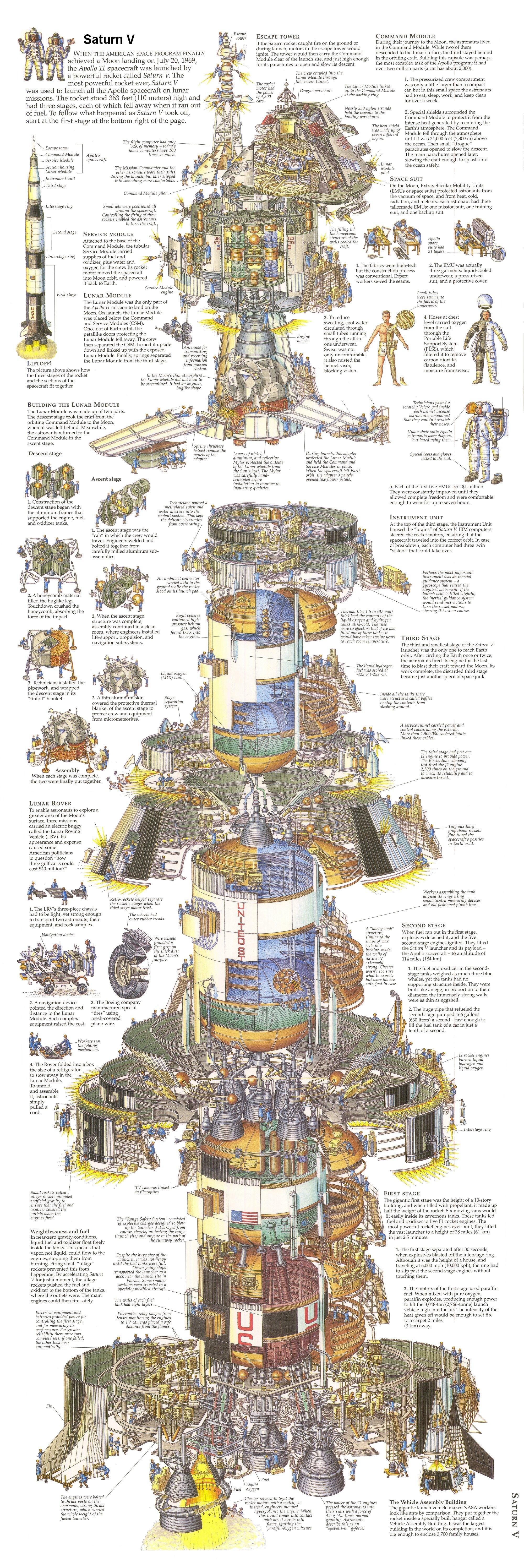
A neat cartoon cutaway of the Saturn V launch vehicle.
"Asteroid Mining may seem like science fiction, but with resources running short on Earth, mining the sky could be humanity's only hope."
3D printing is beginning to bring changes to producing rocket parts. Several people and organizations have stated publicly that they are using 3D printing to make parts for rockets.
Paul BreedIn his business plan Paul Breed says that he's likely the first person to make a regeneratively cooled combustion chamber using 3D printing. Here are some pictures of his motor:
Trying the 3D print thing again....Rocket Moonlighting blog has shown several motors made using 3D printing:
Plastic RocketsHere's a recent article on using 3D printing for rocket motor parts:
NASA's Space Launch System Using Futuristic Technology to Build the Next Generation of RocketsNASA's Marshall Space Flight Center in Huntsville, Ala. is using a method called selective laser melting, or SLM, to create intricate metal parts for America's next heavy-lift rocket. Using this state-of-the-art technique will benefit the agency by saving millions in manufacturing costs.
Turbopump PartsParts for turbines and pumps are already being made using 3D printed technologies
EOS has manufactured turbine nozzle guide vanes as well as turbine impellers:
Aerospace ApplicationsHere's a picture of a turbine impeller:
Turbine ImpellerIn order to get started, here's a basic process:
3D printing is a technology with great promise for making rocket parts. As this Forbes Article states, it's a rapidly growing and large industry. There are many benefits that can be derived by considering using it for producing rocket parts. It can allow the production of small run parts at fairly reasonable prices.