was pretty easy. Nonetheless, it is worth putting the stage information in
a format that can make comparisons easier with other similar launchers.
However, it looks like we can safely say that the Vanguard is the second
smallest land-based launcher (by mass).
In summary, the Vanguard was a small three stage rocket launcher able to
place 22 lbs payloads into orbit. The first stage used liquid oxygen (LOX)
with kerosene as the fuel. The second stage used nitric acid with UDMH
as the fuel. The third stage was a solid rocket motor without guidance.
The second stage was responsible for orienting the third stage prior to
its ignition to ensure a proper orbit. As the Engineering Summary document
states:
    "A three stage vehicle, with two guided stages and an
    unguided but spin-stabilized third stage, fired at
    second stage apogee, represented the most efficient
    vehicle combination consistent with rocket technology
    at that time."
One of the most obvious things about the Vanguard versus a solid launcherlike the Lambda 4S is that it has substantially lower mass ratios. Even
though the Vanguard is only a 3 stage vehicle, doesn't have substantially
higher Isp, it outperforms the Lambda 4S in delta V despite a larger effective payload.
THE STATISTICS
Here's the statistics table for Vanguard SLV-1. The SLV-1 was preceded by
six test vehicles, TV-0 through TV-5, and was the first operational version
of the design series. Later versions had numerous improvements over this
basic design. Although SLV-1 failed to place a payload in orbit, it represents
the basic Vanguard design and is the one that I used for my analysis. The
reason for SLV-1's failure likely was a control system problem which resulted
in stage 3 having an improper trajectory.
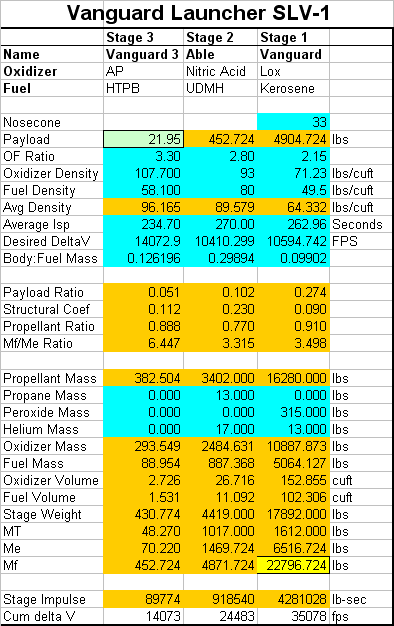
It should be pointed out that the calculated Gross Liftoff Weight (GLOW) is
different than that in the Engineering Summary document. This is because
they use a weight which includes ice on the Lox tank and aerodynamic
surfaces used on the ground to minimize wind shaking of the vehicle.
Therefore, the GLOW used in the analysis subtracts out the ice and
aerodynamic wind breaks.
One other significant issue is that the nosecone is properly part of stage 2
but its weight is included in stage 1. The reason for this is that the nose cone
is ejected from stage 2 shortly after separation and therefore, its effects
are not felt by stage 2 but mostly by stage 1.
STAGE 1
Although the Engineering Summary document is authoritative, making sense
of the effects of various weights on stage 1 requires careful attribution
of various weights to the overall stage performance. In the Rocket Equation,
it is important to get the weight at liftoff (GLOW) and the weight at stage
burn out correct as well as the effective specific impulse (Isp). These weights
have to be factored properly into the analysis or the results will not be
as accurate as one might desire.
In the case of stage 1, it is necessary to figure in the weights of the
Hydrogen Peroxide and the Helium used in the propulsion system and account
for their effect on both the weight and the effective propulsion system
efficiency as expressed by the average Isp. This means that the weights
of these fluids must be included into the weight of the "propellants"
which includes the oxidizer and the fuel. Doing so, gives the stage
weights below:
Fuel and Oxidizer:      15952 lbs
Helium:                    13 lbs
Hydrogen Peroxide:        315 lbs
---------------------------------
Propellant Weight:      16280 lbs
It should be noted that the total Hydrogen Peroxide weight was given
as 340 lbs, but only 315 lbs is reported as having been used. Therefore,
the additional 25 lbs was assigned to the burnout weight of stage 1.
Reported Emtpy Wt:       1587 lbs
Unused Peroxide:           25 lbs
---------------------------------
Burnout Weight:          1612 lbs
The first stage engine used a turbopump to raise the propellant feed pressure
to 616 PSI. The exhaust gas of the turbopump was directed to roll control
nozzles to provide attitude control beyond the stage 1 motor gimballing.
STAGE 2
Stage 2 used pressure fed nitric acid and Unsymmetrical DiMethyl Hydrazine (UDMH)
as propellants. The motor used was an Aerojet AJ10-37. The AJ10 motor, with
improvements, has continued to be used to this day in the Delta II upper stage.
With variations, this motor has also been used on the Apollo Service Module and
on the Shuttle's Orbital Maneuvering System. This motor has a long history from
the first American orbital attempts to this day.
One surprising aspect of stage 2 is its use of liquified propane as the attitude
control gas for roll control. A blanket heater was used to keep the propane
vapor pressure at 240 PSI. Again, the propane's weight has to be taken into
account for the stage performance
Fuel and Oxidizer:      3372 lbs
Propane:                  13 lbs
Helium:                   17 lbs
--------------------------------
Propellant Weight:      3402 lbs
STAGE 3
Stage three used a solid rocket motor which was spun along its axis to
maintain orientation. The second stage essentially used "point and
shoot" with the third stage and it contained the guidance system.
A spring-loaded separation device separated the payload from the third
stage motor at the appropriate time.

PERFORMANCE SUMMARY
Based on the vehicle defined in the performance table, above, an
aerodynamic model and an Isp vs altitude model, a simulation was
performed to identify various performance characteristics. The
trajectory was made to match the published values in the Engineering
Summary. From this, we can estimate gravity and aerodynamic losses
of the first stage.
Designed delta V:       10594.742 fps
Observed delta V:        6399.13  fps
Aerodynamic Losses:       440.31  fps
Gravity Loss:            3755.302 fps
Additionally, we can observe the apparent allocation of delta velocity (delta V)
to each stage:
Stage 3:                14072.890 fps
Stage 2:                10410.299 fps
Stage 1:                10594.742 fps
-------------------------------------
Total:                  35077.931 fps
SUMMARY
The Vanguard satellite launcher provides an interesting example for those
interested in small launch vehicles. The idea of a small launch vehicle
with an unguided final stage provides one way to simplify the design
and development task. It drops the weight of the guidance system from
the final stage where it will have the greatest impact on launch vehicle
weight, down to the second stage where it will have less effect.
The Vanguard satellite launch vehicle is a fascinating example of a
small orbital launcher.
REFERENCE
The Vanguard Satellite Launching Vehicle - An Engineering Summary
http://hdl.handle.net/2060/19740072500
